
How avid players follow the sun, tracing a path from Florida’s winter clay empires to New England’s storied summer retreats
There is a certain breed of tennis player who cannot be stopped by the weather, and the debate over winter tennis in Florida vs. summer tennis in New England resorts is one they live rather than argue. When the first frost coats the courts of the Northeast each October, they begin packing their racquet bags. When the summer humidity turns a Florida afternoon into a slow-motion sauna, they point their cars north. Tennis players, it turns out, are migratory creatures. The routes they travel have carved out two of the most distinct and storied resort cultures in American sport.
From the moss-draped Har-Tru courts of Amelia Island to the crisp mountain air above Stratton, Vermont, the East Coast offers a year-round pilgrimage for the dedicated player. But Florida’s winter haven and New England’s summer retreats are far more than geographical opposites. They represent fundamentally different philosophies of play, lifestyle aesthetics, social cultures, and court personalities, each one shaped by its climate, its history, and the players it draws.
Understanding the difference between them is the first step to booking the right trip.
Winter Tennis in Florida vs. Summer Tennis in New England Resorts: What the Weather Means for Your Game
Winter Tennis in Florida (November – April)
Step onto a Florida court in January, and you’ll immediately understand why the snowbirds come in flocks. Temperatures hover in the comfortable 60s and low 80s, a world away from the sub-zero freezes gripping the Midwest and Northeast. The air is warm, the sky is wide, and somewhere nearby, someone is ordering a post-match poolside cocktail at 10 in the morning and feeling completely justified about it.
But Florida’s winter climate comes with one genuine caveat: the UV index remains higher than most visitors expect, even when humidity is low, and the breeze feels mild. The winters are dry and warm with a tropical breeze. The playing window is genuinely generous, and there’s none of the urgency to beat the heat that defines summer tennis here. The one thing serious players do adjust to is the sun itself. Even on crisp, low-humidity days, UV rays are strong enough to cause cumulative damage during long outdoor sessions, so sunscreen and a hat become as standard as a spare grip. Beyond that, Florida winter tennis has a rare, unhurried quality. It’s the kind of place where you can book a midday match, linger through a long warmup, and still feel like the day is entirely on your side.
The iconic destinations are scattered across the state’s coastal jewels: Palm Beach, Naples, Amelia Island, and Tampa Bay. Each one offers its own blend of luxury, water, and world-class courts.
Summer Tennis in New England Resorts (June – August)
Arrive at a Vermont mountain resort on a July morning, and the contrast is immediate. The air is cool and damp, the courts still holding the night’s moisture, the tree line a deep green against a sky that seems taller somehow than it does at sea level. There is no race to beat the heat. There is no compressed morning window. There is, instead, the rare gift of simply playing tennis all day.
New England’s summer climate, with crisp coastal mornings on Cape Cod and breezy alpine afternoons in the Green and White Mountains, removes the urgency that defines Florida play. Temperatures stay comfortably throughout the day, inviting a more deliberate, unhurried approach. Players take long lunches. Families move between courts and hiking trails. The evening light lingers long past dinner.
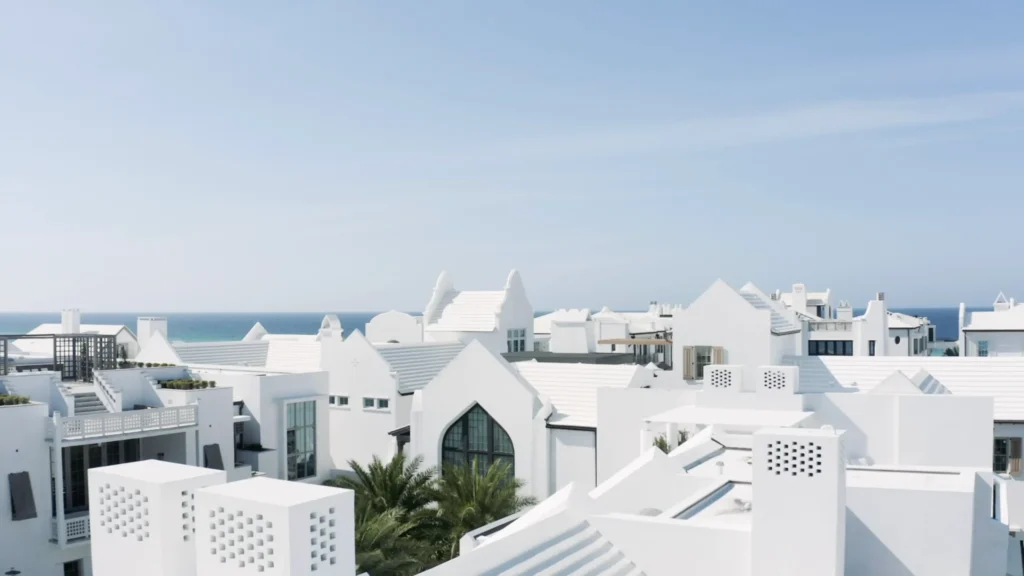
The destinations carry names that echo with history: the Ocean Edge on Cape Cod, Waterville Valley tucked into the New Hampshire mountains, Stratton in Vermont, and the coastal estates of Rhode Island. These are places that have been hosting tennis players for generations, and they look the part.
The Courts Themselves: Surface, Physics, and Style of Play
The difference between Florida and New England tennis isn’t just temperature. It lives in the ground beneath your feet.
Florida’s Har-Tru Empire
Florida’s resort courts are dominated by Har-Tru, the green clay surface that has defined Southern tennis for decades. Har-Tru retains moisture well, stays cool underfoot even in the heat, and absorbs the impact of hard-hit groundstrokes in a way that hard courts simply cannot match. For the joints of an aging competitive player, it is nothing short of a revelation.
Play on Har-Tru, and you’ll notice immediately how it slows the game down. Rallies stretch longer. The ball sits up higher, inviting patience and precision rather than pace. Topspin becomes a weapon. Sliding, the elegant European clay-court technique, becomes not just possible but necessary. This is tennis that rewards the grinder, the tactician, the player who wins by outlasting rather than overpowering. It is no coincidence that the surface is beloved by Florida’s famous snowbird demographic: the active-adult players who have been competing for decades and know that endurance beats explosion over the long run.
New England’s Historic Variety
New England’s courts offer something rarer and more varied. There is red clay, the slow ochre surface reminiscent of Roland Garros, still found at places like the Omni Mount Washington. There are modern hard courts. And then, most prized of all, there is grass, the surface of Wimbledon, still maintained at historic clubs in Newport, Rhode Island, where the game was first played on American soil.
Grass changes everything. The ball skids low and fast. The bounces are unpredictable. The serve becomes a weapon of extraordinary power, and the net beckons with sudden urgency. Serve-and-volley tennis, the attacking, aggressive style that defined the sport for much of the 20th century, finds its natural home here. If Florida rewards patience, New England rewards boldness.
The Culture of the Courts
The Florida Snowbird Scene
Florida’s winter tennis culture is polished, performance-focused, and unapologetically modern. The courts are new, the gear is technical, and the social infrastructure is tightly organized. Round-robins run on schedule. Club ladder matches are contested with genuine competitive seriousness. Pro-Am exhibition tournaments draw serious crowds. Post-match, the action moves to poolside cabanas and world-class spas. The social center of gravity is the adult competitive player: fit, focused, and deeply invested in improving their game.
The New England Heritage Scene
New England’s summer tennis culture operates on a different frequency entirely. The luxury here is more understated. Canvas bags. Wooden details. At select historic clubs, white dress codes still hold.
The social structure is more family-oriented, built around multigenerational “camps” where grandparents and grandchildren share the same courts, and the post-match conversation is just as likely to be about a hiking trail as a backhand. Cliff Drysdale’s program at Stratton Mountain perfectly captures this spirit: serious technical instruction in the morning, mountain breezes and lawn sports in the afternoon, craft brewery in the evening. It is tennis as a lifestyle rather than a discipline, woven into a broader fabric of outdoor culture, farm-to-table dining, and historic village charm.
The Resorts: Where to Book Your Migration

Florida’s Premier Winter Courts
Saddlebrook Resort & Spa (Wesley Chapel) has earned its reputation as the ultimate training mecca. Freshly emerged from a $92 million renovation, the resort’s 41 courts span all four Grand Slam surfaces: hard, clay, red clay, and grass. Home to the legendary Hopman Tennis Program, whose alumni include Pete Sampras, Martina Hingis, and Alex Zverev, Saddlebrook is also the global headquarters for the Professional Tennis Registry. For any player who arrives with a specific stroke to overhaul and the commitment to do the work, there is no more serious address in Florida.
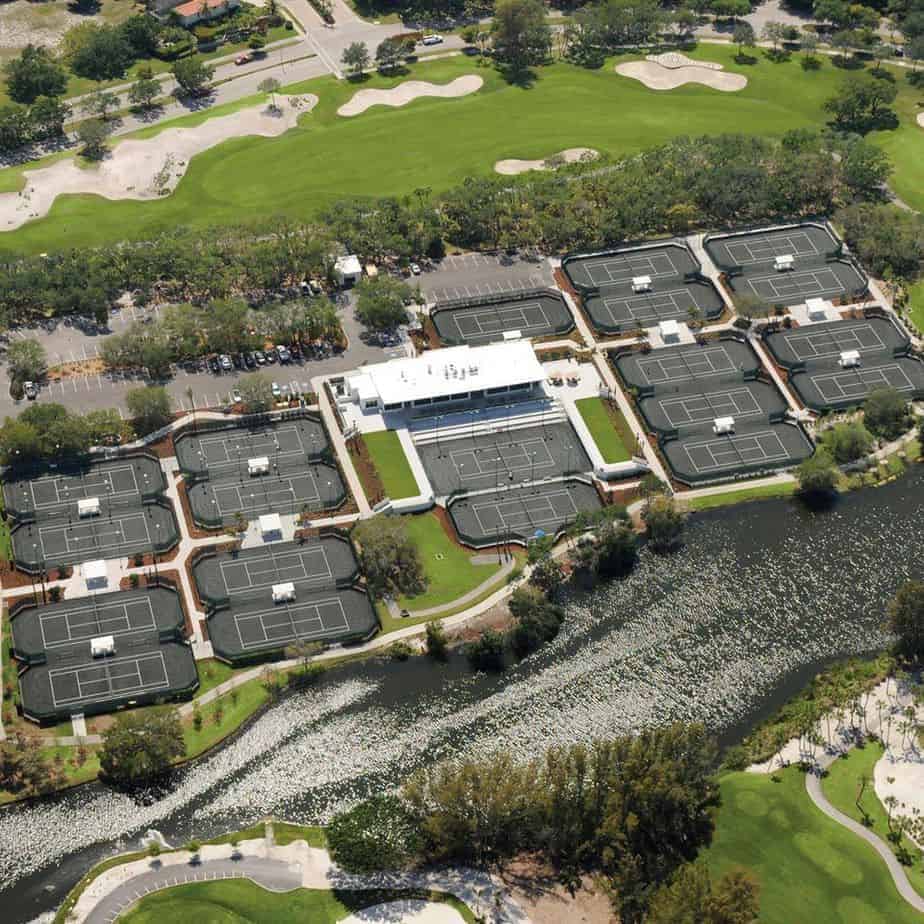
Omni Amelia Island Resort & Spa (Amelia Island) is Florida tennis at its most atmospheric. Since 1974, players and professionals have been drawn to its 23 Har-Tru fast-dry clay courts, set beneath a canopy of ancient live oaks at Racquet Park, three of which are lighted for evening play. Operated by Cliff Drysdale Tennis under the direction of Rob Wright, the program offers year-round clinics, adult camps, ladies’ retreats, and junior options. Tennis legends, including Andre Agassi, Martina Navratilova, Chris Evert, and the Williams sisters, have all played here.
The Resort at Longboat Key Club (Longboat Key) is one of the most court-rich destinations in the South. With 24 Har-Tru courts, five of them lit for evening play, the club supports one of the most active winter programs on Florida’s Gulf Coast. Director Briana Harris Francois oversees a calendar built around the Sarasota social season, offering Morning Madness clinics, all-level doubles strategy sessions, and live-ball drills that draw strong participation from November through April. The full resort package includes a spa, golf, and direct Gulf access.
The Ritz-Carlton, Key Biscayne – Cliff Drysdale Tennis (Key Biscayne) is the largest and most complete tennis and padel venue of any Ritz-Carlton resort worldwide, according to Cliff Drysdale Tennis. The Cliff Drysdale Racquet Garden features 11 courts just five miles from downtown Miami, managed by director Max Mangones and a staff of international pros. The program offers comprehensive adult and junior clinics, a High Performance Academy, private lessons, summer day camps, and social leagues. For players who want high-level instruction with the full backdrop of a Miami beachfront luxury resort, it is hard to match.
Hammock Beach Golf Resort & Spa (Palm Coast) is one of Florida’s most decorated tennis addresses. The Racquet Center features eight lighted Hydro-Grid clay courts overlooking the Intracoastal Waterway. Director Gene Paul Lascano, a PTR and USPTA Elite Professional with more than 25 years of coaching experience, leads a program that has built notably strong repeat-guest loyalty. For players seeking a quieter alternative to the intensity of South Florida, Hammock Beach delivers serious tennis in a more relaxed coastal setting.

New England’s Premier Summer Retreats
Stratton Mountain Resort (Vermont) carries some of the richest tennis history in the Northeast. The Volvo International drew the world’s top players to Stratton from 1985 to 1989, and it was on these courts that a teenage Andre Agassi first played his way onto the national stage. Today, Cliff Drysdale Tennis director Robert Menzies oversees a sports complex of six red-clay courts, four outdoor hard courts, and two indoor hard courts. The summer program includes daily clinics, adult weekend camps, a junior academy, and a Mountain Strong program developed specifically for teen players.
Waterville Valley Resort (White Mountains, New Hampshire) may be the most historically rooted tennis destination in the entire Northeast. The first clay court here dates back to 1884 and has been in continuous use ever since. Director Tom Gross Jr., who trained alongside Rod Laver, Roy Emerson, and Lew Hoad, oversees 18 red-clay outdoor courts and two indoor courts at the nearby Athletic Club. Morning clinics, daily adult round robins, and a summer junior program run from Memorial Day through the fall, all set against a Town Square ringed by the peaks of the White Mountains.
Topnotch Resort – Topnotch Tennis Academy (Stowe, Vermont) carries a storied tournament pedigree, having hosted the Head Classic Grand Prix event in the early 1980s and a Fed Cup tie in 2007. There are 10 tennis courts: 6 outdoor and 4 indoor. The signature Adult Tennis Academy runs themed morning clinics covering groundstrokes, net game, transition play, and footwork, supplemented by afternoon point-play sessions. The 35,000-square-foot Topnotch Spa, an equestrian center with guided trail rides, and Stowe’s full culinary and outdoor scene round out the experience.
The Essex Resort & Spa (Essex Junction, Vermont) offers the most distinctly boutique take on the New England tennis escape. Six outdoor Har-Tru courts anchor a full resort that also includes a 21,000-square-foot spa and a celebrated teaching kitchen where guests take hands-on culinary classes. Director Rob Barr, a 25-plus-year coaching veteran with experience on both the WTA and ATP Tours, runs a weekly program of clinics, junior sessions, and mixed scrambles from May through October, with customizable camps available from mid-July to September. For players who want spa recovery, Vermont farm-to-table food, and serious court time under one roof, The Essex is the rare place that delivers all three.
Owl’s Nest Resort (Thornton, New Hampshire) offers the most under-the-radar clay-court experience in the White Mountains. Eight red-clay courts in the White Mountains are directed by Cosmin Chiujdea, a former Top 10 junior in Romania who came up through the U.S. college tennis system before taking over operations at Owl’s Nest in 2023. His weekly program includes clinics at all levels, drill sessions, men’s and ladies’ nights, and summer junior day camps, all held at a resort that also features a highly regarded golf course. For players seeking a less-discovered White Mountains alternative with genuine clay-court credentials, Owl’s Nest is worth the detour.
Practical Realities: When to Book Winter Tennis in Florida vs. Summer Tennis in New England Resorts
Timing Is Everything
Florida’s winter courts operate at full peak-season intensity from January through April. Premium court times fill weeks in advance, resort rates hit their annual highs, and the competition for tee times and restaurant reservations is real. Come prepared, and come early in the planning process.
New England’s window is even narrower and in some ways more precious for it. Twelve weeks, from Memorial Day to Labor Day, is just about all you get. The smart move is early-spring planning, before the summer calendar fills and before the best camp slots disappear to repeat guests who know exactly what they’re booking.
The Pickleball Question
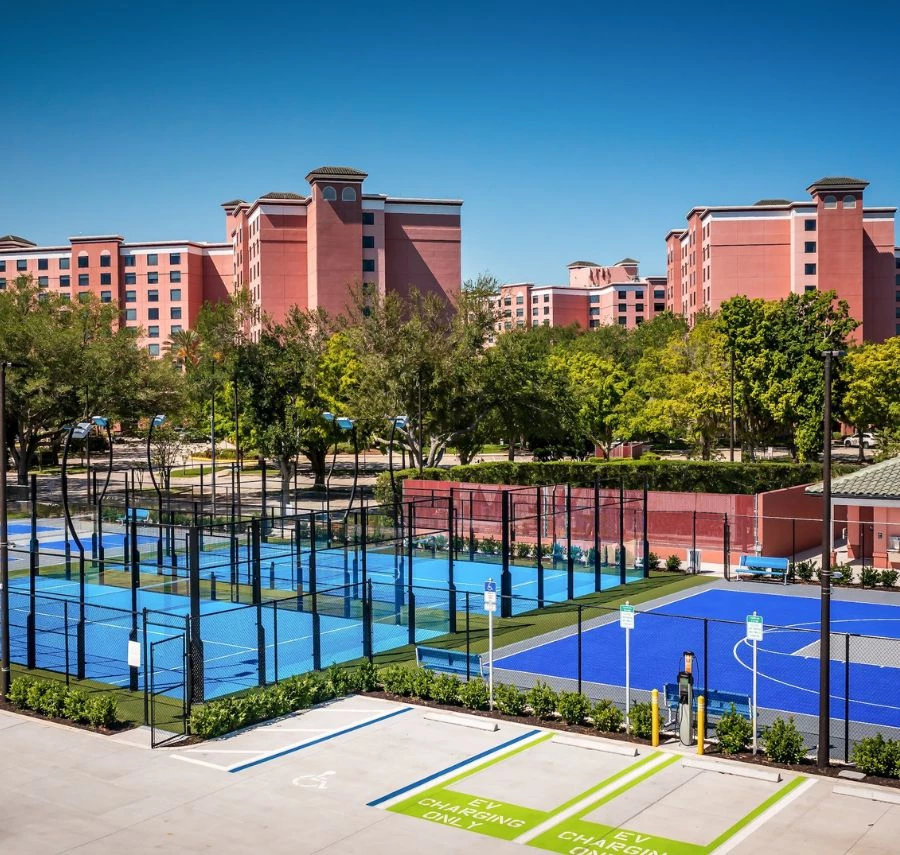
No honest survey of American tennis resort culture in 2026 can ignore what is happening on the neighboring courts. Both Florida and New England resorts are actively integrating pickleball and padel into their court infrastructure, partly to capture younger demographics and partly to maximize court utilization during shoulder hours. At most major resorts, the two cultures now coexist. For the dedicated tennis purist, the sport is still centered and celebrated. But the racquet sports world is broadening, and the best resorts are expanding with it.
The Migration Never Ends
Here is the thing that the most devoted tennis travelers understand instinctively: when it comes to winter tennis in Florida vs. summer tennis in New England resorts, there is no wrong answer, only a question of timing. Florida and New England are not competitors. They are complements. One offers the winter escape, the soft green clay, the poolside glamour, and the morning rush to beat the heat. The other offers the summer retreat, the crisp mountain air, the grass courts, and the long afternoon light.
Together, they form a year-round circuit, a pilgrimage that the dedicated player can follow indefinitely, always chasing that perfect 72-degree morning, always finding a new court to fall in love with.
The only question is where you start. And that, in the end, comes down to who you are as a player on the court.
Frequently Asked Questions
Florida offers premier winter tennis destinations featuring extensive Har-Tru green clay courts. Top choices include the newly renovated Saddlebrook Resort & Spa with 41 courts, Omni Amelia Island Resort & Spa’s historic Racquet Park, the court-rich Resort at Longboat Key Club, The Ritz-Carlton in Key Biscayne, and Hammock Beach Golf Resort & Spa.
New England boasts storied summer retreats featuring historic clay and grass surfaces. Elite destinations include Stratton Mountain Resort and Topnotch Resort in Vermont, both known for their rich tournament history. Waterville Valley Resort and Owl’s Nest Resort in New Hampshire offer exceptional red-clay courts, while The Essex Resort & Spa combines tennis with boutique culinary programs.
Yes, these premier destinations feature world-class training programs. Florida resorts host renowned operations like Saddlebrook’s Hopman Tennis Program and Cliff Drysdale Tennis at Omni Amelia Island and Key Biscayne. For summer travelers, New England alternatives like Cliff Drysdale’s academy at Stratton Mountain, or the comprehensive technical clinics at Waterville Valley, Topnotch Resort, and The Essex.
Florida resorts predominantly feature Har-Tru green clay, which slows play and reduces joint impact. For players seeking variety, New England resorts offer a diverse mix of surfaces, including rare grass courts in Newport that favor fast serve-and-volley styles, traditional hard courts, and European-style red clay found at locations like Owl’s Nest and Waterville Valley.
Timing is critical for these popular destinations. Florida’s winter tennis season peaks from January through April, requiring early booking for prime court times and accommodations. New England’s summer tennis window is much narrower, lasting only twelve weeks from Memorial Day to Labor Day, making early spring the ideal time to secure resort reservations and academy slots before they fill up.
Tennis resorts are rapidly evolving, and by 2026, many premier properties will have integrated pickleball and padel into their infrastructure to welcome broader racquet sports demographics. While dedicated tennis programming remains the core focus, venues like The Ritz-Carlton, Key Biscayne, feature extensive padel facilities, and both Florida and New England resorts actively co-exist with these growing sports.